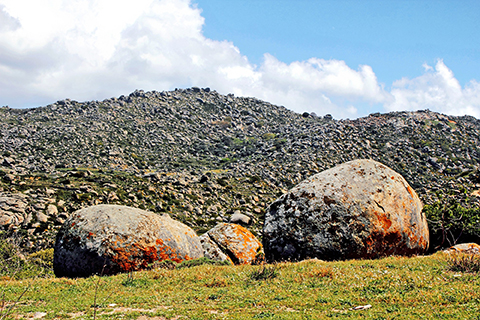
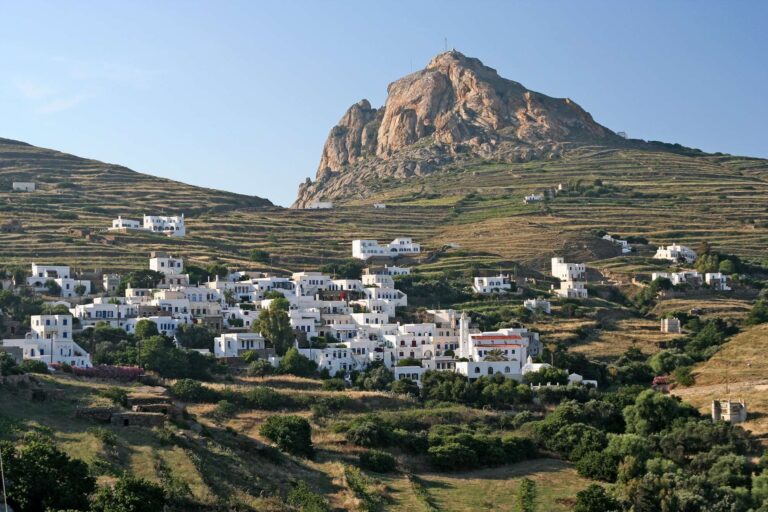
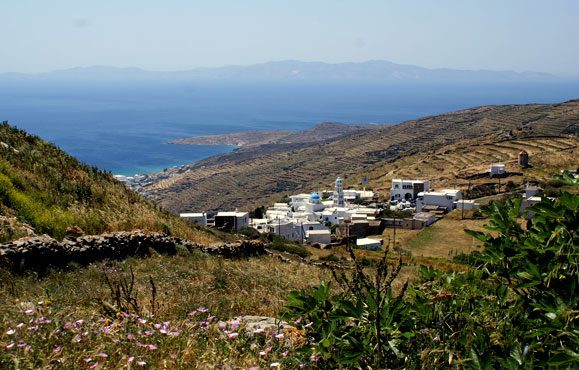
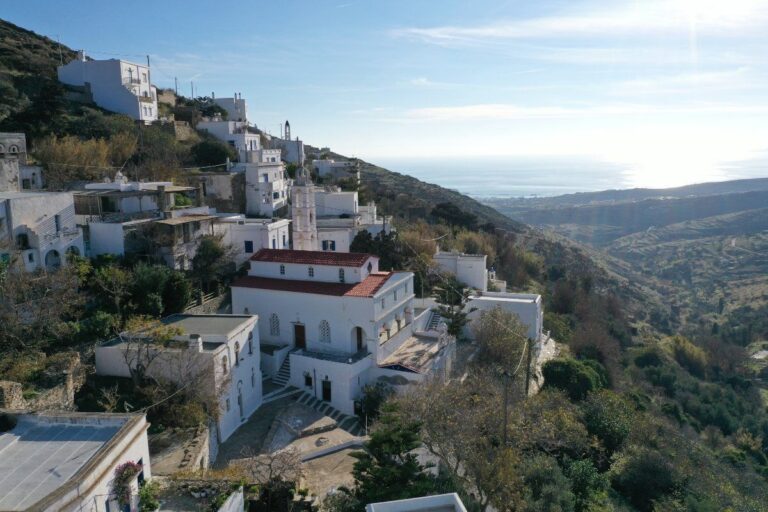
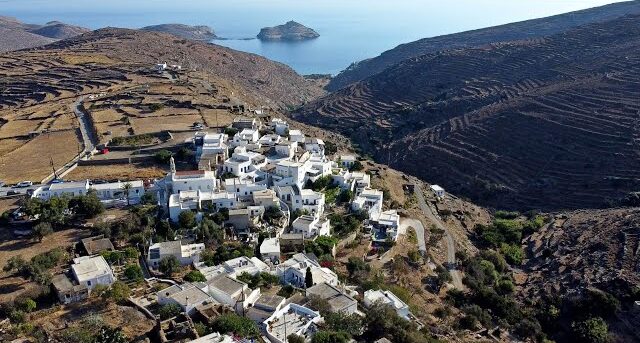
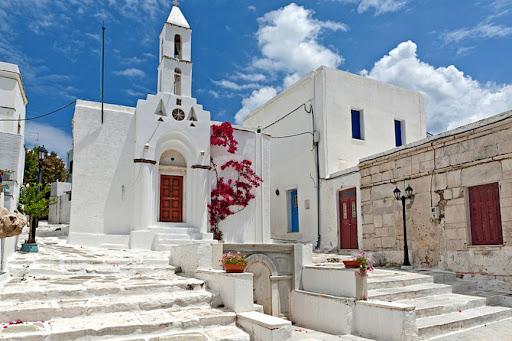
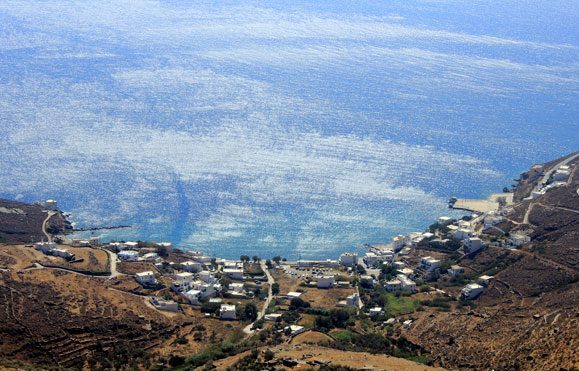
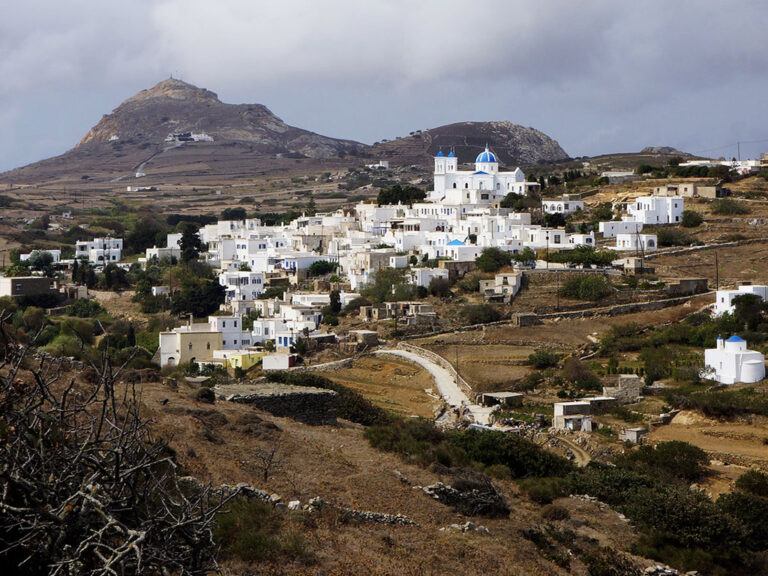
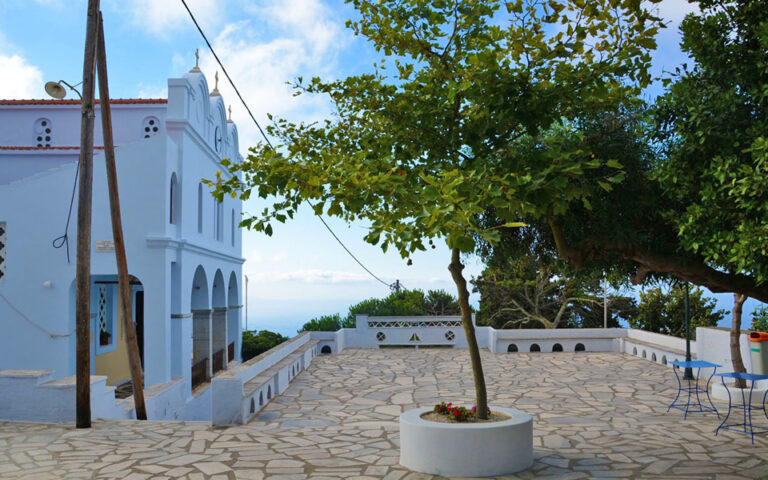
The thousands of impressive smooth granite boulders, which are scattered in the area, create an almost lunar landscape, in a village that seems to balance artfully between myth and reality attracting the interest of scientists and visitors alike! No matter how many photos you take of this medieval village, there will never be enough! Between them the white houses create a spectacle of unprecedented architecture. Charming signs will lead you to the small theater, the 1886 fountain, the Catholic Church of the Nativity and the folklore museum!
Dyo Horia village
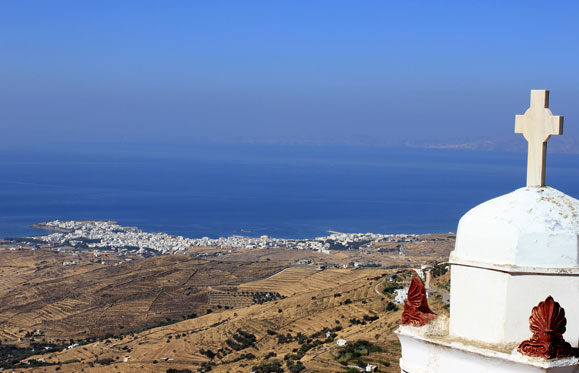
Built at an altitude of 450 m, Dio Choria has perhaps the most unique panoramic view. Together with the neighboring villages, they are considered the “best view” villages of Tinos thanks to the wonderful field of vision they offer!As its name states, originally there were two settlements that joined to create this beautiful village built on a green slope, it has a simple architecture, narrow streets, while from their large square ,the view of the Cyclades islands of the central Aegean is impressive. Fountains with gurgling water, paved paths and bougainvillea in full bloom, frame the tall plane trees of the main square and the picturesque medieval arches on the best “balcony” of Tinos.
Kardiani village
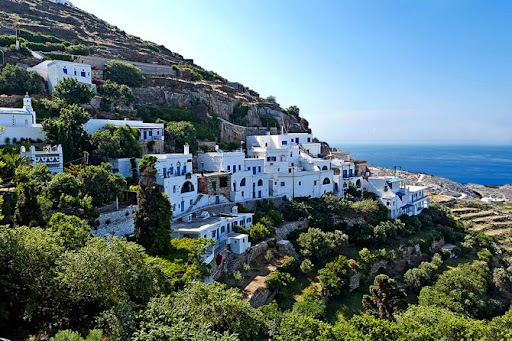
The whitewashed streets and flower-adorned gardens, the wonderful architecture and the embossed decorative details effortlessly draw the visitor’s eye to the mountain village with the marble fountains , on the southwest side of the island. Dazzlingly white and architecturally adorable, it will enchant you! Built amphitheatrically on the side of Mount Pateles, 16 km from the town, Kardiani is one of the most beautiful villages of Tinos with magnificent architecture and an impressive view of the sea!It is a very green village with running water, centuries-old Plane trees and picturesque alleys. In this village you can also see both its Catholic churches!
Koumaros village
One of the smallest but most special villages of Tinos, with a population that barely reaches 30 people. Built on the steep slope of the Fourka mountain, it certainly offers an excellent view. Near it you will find the abandoned monastery of Agia Angela, while it is also the closest village to Exomburgos and is connected by a path to the old castle.
Ktikados village
Traditional houses and churches, stone-paved alleys, arches, lintels and fountains make up the traditional and particularly picturesque puzzle of Ktikados, which is located near Chora of Tinos.
Mountados village
At a distance of about 8 km from Chora, there is the traditional settlement, located on a slope of Kehrovouni mountain, with its history starting about 1,000 years ago. Mundados has always had a great tradition in shipping and trade, while one of the few schools on the island and one of the most famous olive mills operated here. Its trademark, the stream with the stone bridge.
Panormos village
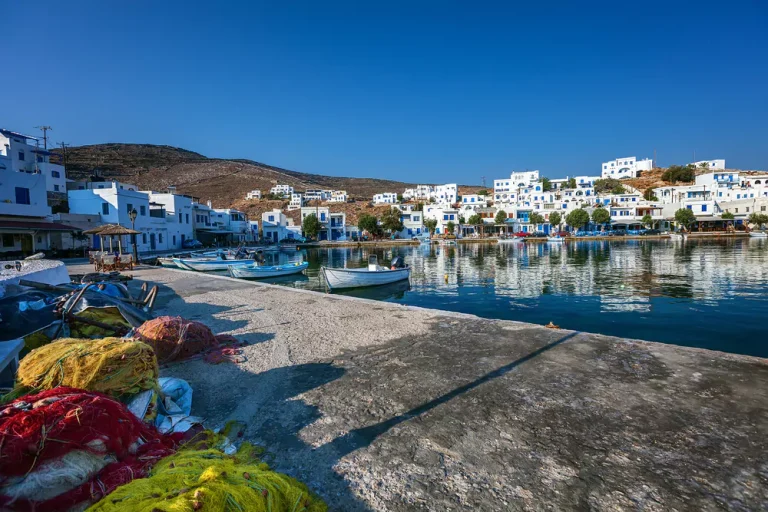
The small fishing village in the western part of the island has been classified as a traditional settlement and has crystal clear sandy beaches. Close to it, the islet of Planitis stands out with the ruined Lighthouse (which operated for the first time in 1886 and is a preserved historical monument) right across from the port. A beautiful fishing village in the mountains of the island which is a natural picturesque harbor with fish taverns next to the sea. This is the port of Pyrgos and one of the most beautiful destinations in Tinos. In the past it was one of the most important ports of the island as goods from Greece and abroad arrived there with dozens of boats.
Platia village
Traditional settlement and classic example of Tinian architecture. The small preserved village near Pyrgos also happens to be the birthplace of many artists. Masterfully worked stone and marble easily arouse interest. At every step, the masterfully worked stone and marble cannot help but pique your interest!
Pyrgos village
The largest and most popular village of Tinos retains its Cycladic architecture unchanged, with marble fountains, iconography and house facades making it look like an outdoor art exhibition. Its name is due to the Venetian tower built in the 16th century for the defense of the area. It highlighted many of the most important Greek artists, among them the sculptors Giannoulis Halepas, Dimitrios Filippotis, Giannis Voulgaris, Loukas Doukas and the painter Nikiforos Lytras. Every corner in the village of the genius Giannoulis Halepas, has been decorated with marbles, icons and traditional doors. Its square is truly unique: Marble-paved, with the characteristic plane tree and the traditional marble fountain, as well as plenty of options for food and coffee.Pyrgos, keeps its Cycladic architecture unchanged while the whole scenery make it look like an open-air Art exhibition!
Ysternia village
Built at a distance of about 18 km from Chora, date from about 1600 AD. Glyni square, the old primary school, the churches of Agia Paraskevi, Agia Triada and Agia Anna easily convince the visitor of the great tradition of its inhabitants in the art of marble. It is perched on the slope of Meroviglia mountain and offers an amazing view that reaches as far as Syros. Marble-paved streets, arches, courtyards compose a scene of incomparable beauty, while to the north of the village dominate the ruins of windmills, examples of past glory that have been classified as preserved monuments. The village was home to great marble craftsmen, whose works you will see in the artists’ museum.
Falatados village
Built amphitheatrically opposite Kehrovouni, It is the third largest settlement of the island after Chora and Pyrgos. The village dates back to 1400 and is famous for its raki! In fact, in September there are many festivals during the production of raki. Walking through the cobbled streets that go under arches you will see the church museum, taverns and cafes and of course the imposing church of Agios Ioannis. The Church of the Holy Trinity with its blue dome stands out from afar, while the sketch-cartoon Museum, is one of the only ones in south-eastern Europe.
Arnados village
The picturesque village is the most mountainous of Tinos, built on the side of Kehrovuni mountain, close to the monastery of Agia Pelagia and 15 km from the village. It is one of the oldest villages famous for its cobbled streets with medieval arches and the Church of the Ascension of Christ that dominates the large square. Walking through its alleys you will come across marble fountains cafes houses with courtyards full of flowers and the folklore museum as well as the ecclesiastical museum.
Scroll to Top
We use cookies to ensure that we give you the best experience on our website. If you continue to use this site we will assume that you are happy with it.